


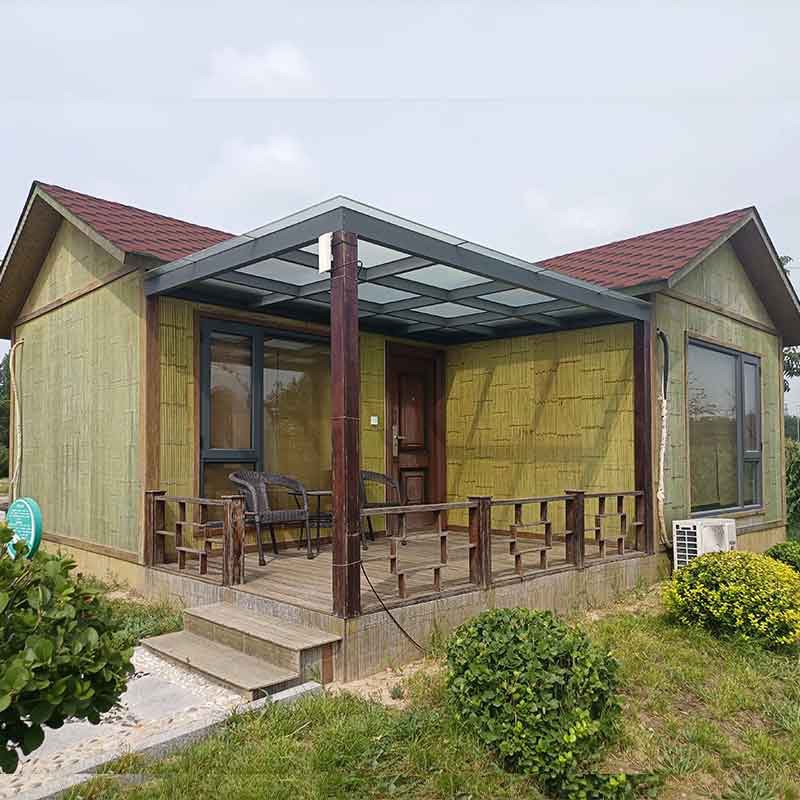
Bamboo Integrated House
Zhejiang Yanjie Building Template Co., LTD., founded in 1999. Is the national formwork scaffolding industry well-known enterprises and one of the top 60 enterprises. The company has four supporting bamboo wood-based panel production lines and corresponding glue-making equipment, and the annual production capacity of bamboo plywood formwork is more than 25,000 cubic meters, and the output and output value of products are increasing year by year.


Why choose us?
Our factory
The registered capital of the company is 10 million yuan, the total assets are 50 million yuan, the net assets are more than 10 million yuan, the fixed assets are more than 24 million yuan, and the main machinery and equipment are more than 200 sets.The company has four supporting bamboo wood-based panel production lines.
Our product
The main products of the company are: bamboo particleboard, high-grade laminated bridge special template, high-rise building special template, car bottom, bamboo laminated plastic board and bamboo composite board.
Production market
The company's bamboo template products in addition to meet the needs of domestic users, but also exported to the United States, Angola, Vietnam and other countries.
Our service
Design services: Simple customization, Customization based on sample, Customization based on graphic design, Customization
Types of Bamboo Integrated House
Bamboo frame houses are similar to conventional wooden frame houses in design. They have a structural framework made of bamboo poles. The bamboo is used to build the floors, walls, roofs, and sometimes the foundations. Bamboo frame houses can be easily customized to meet different needs and preferences. They are also suitable for different climates and terrains. These houses are more environmentally friendly than conventional houses since they use less concrete and steel materials.
Bamboo panel houses have walls made of prefabricated bamboo panels. These panels consist of bamboo poles that are tightly bound and filled with materials like cement, straw, or clay. The panels provide structural support and insulation. Bamboo panel houses are usually quick to assemble since the panels are prefabricated. They are also more energy-efficient than bamboo frame houses due to the insulating properties of the panels.
Bamboo modular houses are constructed using bamboo modules or units. Each module contains a complete section of a house, like a bathroom, living room, or bedroom. The house is assembled by joining multiple modules. These houses can be built in different sizes and configurations. They can be used as single-unit homes or multi-story buildings. Bamboo modular houses require fewer labor skills for construction as the modules are designed for easy assembly.
Bamboo loft houses have a design that incorporates loft spaces. Bamboo loft houses are built with bamboo poles and have loft spaces for sleeping or working. These houses are open and airy and have high ceilings. They also have exposed beams that showcase the bamboo's natural beauty. Bamboo loft houses are cost-effective and use sustainable building materials.
Bamboo tent houses are lightweight and portable. They have a tent-like structure supported by bamboo poles. The poles create a framework on which fabric or bamboo matting is stretched to form the roof and walls. These houses are ideal for temporary or seasonal use since they are easy to set up and dismantle. Bamboo tent houses can also be used for permanent housing.
Functions And Features Of Bamboo Integrated House:

Below Are Some Essential Functions Of Prefab Bamboo Homes:
Eco-friendly and sustainable: Bamboo is an environmentally friendly and renewable material. It is used to create sustainable prefab homes. Bamboo absorbs a lot of carbon dioxide during its growth, which helps reduce greenhouse gases. Bamboo grows and matures quickly, usually within three to five years. This home uses bamboo as the primary building material, promoting sustainability and environmental consciousness.
Reduced waste: Bamboo can be harvested without destroying the plant or its ecosystem. This minimizes waste and promotes environmental sustainability. Additionally, the construction of bamboo houses often involves prefabrication. This means that parts of the house are made in a factory and then brought to the site. This process helps reduce waste because everything is precisely measured and cut according to what is needed.
Transportable: Bamboo is lightweight. This makes bamboo houses easier to transport. Being lightweight also means that the bamboo house can be moved to different locations with less effort and resources. This flexibility is beneficial in areas where the climate or land suitability changes throughout the year.
Below Are Some Features Of Bamboo Houses:
Resilience: Bamboo is known for its flexibility and strength. This makes bamboo houses resilient to different environmental conditions. Bamboo houses can withstand extreme weather conditions, such as windy or stormy weather, without collapsing or getting damaged. The resilience of bamboo makes these houses last longer and require less maintenance over time.
Versatility and adaptability: Bamboo houses can be adapted to different climates and environments. For instance, in hot areas, the design of bamboo houses can be changed to create better airflow and shade. In colder areas, the houses can be designed to keep heat inside. This adaptability makes bamboo houses suitable for many regions worldwide.
Natural cooling: Bamboo houses provide natural cooling. They are designed to let air circulate properly, which helps keep the inside cool without needing air conditioning. Bamboo houses are built with open windows and doors that allow air to move in and out. This airflow helps cool the house naturally.

Product Parameters:

Certificates:


FAQ